.jpg)
![[endangered_polar_bear.jpg]](https://blogger.googleusercontent.com/img/b/R29vZ2xl/AVvXsEikujYX7PMhMUMSratkT8fEW-0AEZeyJ90VHwErygzisoGI9c5tD8-BED6w35gG35OVdie9h2PoiR2hyE5o4iwe2kjy2X1rX78gY4-7l5pgY_2Nt6RECidmo_vM5OS-YeR3ehcP0yHC1Jg/s1600/endangered_polar_bear.jpg)


Topic: Why Dolphins are endangered?
Dear Editor,
I would like to indicate some comments regarding the article written in why dolphins are endangered which appear in online article from the websites " Saving the Planet". The writer of this article has included some further characteristics of endangered species in dolphins but never cited the types of dolphins that have become endangered. It is because not all types of dolphins are endangered thus it is important for people to be informed of the endangered dolphins species so that public awareness is at a high level.
However, I am still saluting the awareness and concerns of the writer to publish the articles about endangered dolphins and inform it to the public as a method of saving their species from extinction. Dolphins are categorized as mammals since it is not a fish and it is warm blooded which has its own specialty compared to other animals. It can produce a sound by its own and dolphins often travel in herds . Therefore, since the dolphins were endangered, there should be suggestions on how we can protect them from continuously being endangered or becoming extinct in future.
Basically, the writers had done a good job in explaining the endangered species of dolphins and create a sense of awareness among the readers of saving or at least suggesting an idea on how to save the endangered species. The strong evidence given by the writers on how the dolphins have become endangered has strengthen the policy to discourage the element that may lead to the killing of dolphins or hurting them crucially.
Thank you.
Dolphins lover ,
Wan Ezza Atikah bt Wan Sazali
Thursday, April 8, 2010

Wednesday, April 7, 2010
Saved endangered species : Alligator
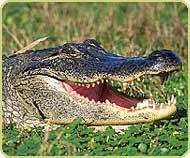
The name of animal that has been successfully brought back from the brink of extinction is American alligator.
Listed as endangered: March 11, 1967
Taken off the list: June 4, 1987
Conservation status :

Least Concern (IUCN 2.3)[1]
Description
Size
- adult male : 11.2 feet (3.4 m)
- adult female : 8.2 feet (2.6 m)
Weight
Exceptionally large males can reach a weight of nearly half a ton or 1,000 pounds.
Other distinct characteristics
Both males and females have an "armored" body with a muscular flat tail. The skin on the back is armored with embedded bony plates called osteoderms or scutes. They have four short legs; the front legs have five toes while the back legs have four toes.
Alligators have a long snout with upward facing nostrils at the end; this lets them breathe while the rest of the body is underwater. The young can be distinguished from adults by the bright yellow stripes on the tail; adults have dark stripes on the tail.
Habitat
Alligators can be found in rivers, swamps, bogs, lakes, ponds, creeks, canals, and bayous. Alligators can tolerate some salt water. However, they can tolerate salt water for only brief periods because they do not have salt glands. And they have been spotted in marshes as well.

More explanation on its recovery status:
Once on the verge of extinction, the American alligator has made a remarkable recovery. Due to strict conservation measures and extensive research, it is no longer endangered except in scattered areas of its range. However, the American alligator is listed as threatened on the U.S. Endangered Species List because it is very similar in appearance to the American crocodile, which is endangered, and hunters are likely to confuse the two species. Hunting is allowed in some states, but it is heavily controlled. The greatest threat is currently destruction of habitat; this includes water management systems and increased levels of mercury and dioxins in the water.
Because alligators will feed on almost anything, they pose a mild threat to humans. In Florida, where there is the greatest alligator population, there were five deaths to alligator attacks from 1973 to 1990. Dogs and other pets are also sometimes killed.
Historically, alligators were depleted from many parts of their range as a result of market hunting and loss of habitat, and 30 years ago many people believed this unique reptile would never recover. In 1967, the alligator was listed as an endangered species (under a law that preceded the Endangered Species Act of 1973), meaning it was considered in danger of extinction throughout all or a significant portion of its range.
A combined effort by the United States Fish and Wildlife Service, state wildlife agencies in the South, and the creation of large, commercial alligator farms saved these unique animals. The Endangered Species Act outlawed alligator hunting, allowing the species to rebound in numbers in many areas where it had been depleted. As the alligator began to make a comeback, states established alligator population monitoring programs and used this information to ensure alligator numbers continued to increase. In 1987, the Fish and Wildlife Service pronounced the American alligator fully recovered and consequently removed the animal from the list of endangered species. The Fish and Wildlife Service still regulates the legal trade in alligator skins and products made from them.
Although the American alligator is secure, some related animals — such as several species of crocodiles and caimans — are still in trouble.
Sources :
i. http://en.wikipedia.org/wiki/American_Alligator
ii. http://www.npca.org/marine_and_coastal/marine_wildlife/alligator.html
iii. http://nationalzoo.si.edu/Animals/ReptilesAmphibians/Facts/FactSheets/Americanalligator.cfm
Endangered species : Giant Panda

Common Name : Giant panda
Scientific Name: Ailuropoda melanoleuca
Location
Southwest China (Gansu, Shaanxi, and Sichuan Provinces) to the east of the Tibetan plateau.
Population : Less than 2,500 mature in the wild
Why Giant Panda is endangered ?
Continuous uncertainty have clouded the future of Giant Panda. With China's economy are rapidly growing, this bamboo-eating member of the bear family faces a number of threats. The first being its forest habitat, in the mountainous areas of southwest China which are increasingly being taken over by roads and railroads. Giant Panda's habitat loss continues to occur outside of protected areas. The second threat which is poaching remains a continuous threat. In 1984, the giant panda was transferred from Appendix III to Appendix I of the Convention on International Trade in Endangered Species of Wild Fauna and Flora (CITES) . Trade in the species or its products are subject to strict regulation by the ratifying parties, and trade for primarily commercial purposes is banned.
Click on this link to help in saving the Panda !
Sources :
i. http://www.panda.org/what_we_do/endangered_species/giant_panda/
ii. www.pandasinternational.org/
Endangered species : Dolphin

Common name : Dolphin
Scientific name : Delphinus delphis
Species : Total up to 60 species
Size : up to 2.5 m / 8 ft long
Habitat
- Tropical and temperate oceans
- some freshwater forms in rivers in Asia, Africa, and South America
Special abilities
Dolphins are famous for their intelligence and learning abilities. Dolphins communicate using an underwater sonar that consists of high pitched whistles and squeaks. Dolphins have a highly developed sense of hearing. Dolphins often travel in groups like a herd.
Why Dolphins are endangered ?
There are many species of dolphins that are endangered such as the Ganges river dolphin , Indus river dolphin , Yangtze river dolphin , Amazon river dolphin and also La Plata river dolphin. The first three are found in Asia and the remaining are found in South American.There are only about 1800 Ganges river Dolphins left while Indus river dolphins numbers only counted to 500 . In January 2000, there were believed to be only five Yangtze river dolphins remaining in the wild.
These dolphins main threat are fishing nets and commercial killing. Several fishing practices have taken a toll on dolphin populations. Most lethal are drift nets and nets called purse seines, used to fish for yellowfin tuna. Because tuna often swim beneath dolphin schools, dolphins are actively searched for. Fishermen then circle the tuna with mile-long (1.6-km) seine nets that trap fish and mammals alike.More than q quarter of million dolphins were killed when this practice started around 50 years ago .Now boat captains are trained to employ manoeuvres that help release the dolphins but still the number of killed dolphins are high at around 20,000 a year.
Other method of fishing is the drift net which is the most indiscriminate killing device yet used at sea.It measured up to 40 miles (64 km) long, drift nets hang draped from floats, trapping virtually everything in their path. Fishermen haul the nets aboard, store the fish or squid, and discard everything else, including dolphins that have drowned while trapped.
sources :
i. http://www.idw.org/
ii. http://www.panda.org/what_we_do/endangered_species/cetaceans/
iii. http://encyclopedia2.thefreedictionary.com/Dolphin+habitat
Endangered species : Amur Leopard

Common name : Amur Leopard
Scientific name : Panthera pardus orientalis
Size
- Adult males: 70 - 105lbs, exceptionally large males weigh up to 165 lbs.
- Females : 55 - 95 lbs.
Color
- Light color in the winter, more reddish-yellow in the summer.
Habitat
- Temperate Broadleaf
- Mixed Forests
Location
- South of the Far East-Primorskii region (Russian Far East)
- Tzilin and Heilundzyan Provinces (Northern China)
Recent numbers : Less than 40
Why Amur Leopard is endangered ?
There are various factors that contributed to the declining numbers of Amur Leopard :
Poaching
Poachers kill Amur Leopard for its fur . Since 2002, skins or corpses of nine Amur Leopards killed by poachers have been found in Russia and at least two other leopards of the same species have been killed in China.
Deforestation
As a result of frequent fires, the forests in which Amur leopards depend on have subsequently disappeared. This fire is mostly originated by the villagers to stimulate the growth of ferns that are a very popular ingredient in the Russian and Chinese dishes.
Inbreeding
Loss in the genetic diversity in the small and isolated population of Amur leopard may cause inbreeding depression, the reduced in the numbers of an animal populations due to reduced reproduction and lifespan and increased vulnerability to diseases. However, the result of the research is so far inconclusive and the information regarding the effects of inbreeding is needed to be collected and analyzed before arriving at a conclusion. The Amur leopard have young every two years.
Development projects
The location of Southwest Primary located close to the Russian borders along with China and Korea, making it an attractive area for infrastructure projects new railways, gas and oil pipelines and ports. The Zoological Society of London and other ALTA partners led a successful international campaign in 2005 and 2006 against a plan to build an oil pipeline terminal on the coast of the Sea of Japan in the leopard’s range.
Sources :
i. http://www.panda.org/what_we_do/endangered_species/amur_leopard2/
ii. http://en.wikipedia.org/wiki/Amur_leopard
Endangered species : Elephant
Elephants species are divided into two types:
i. African elephant
ii. Asian elephant
African elephant

Scientific name : Loxodonta Africana
Habitat
- Tropical and Subtropical Moist Broadleaf Forests
- Flooded Grasslands and Savannas
- Miombo woodlands
- Acacia savannahs
Height
- male : up to 3.6 m
- female : up to 3 m
Weight :
- male : up to 5.4 tons
- female : up to 4.6 tons
Recent numbers : appoximately 690,000
Why African elephant is endangered?
About 25 years ago , there were about 1.3 million elephants in Africa , but now the number had dwindled down to about 690,000 . Poaching has been a mega major thread that contributed to these shocking figure. Mainly , what poachers wanted in African elephants are its ivory which has a very high demand . Hunters make a very good fortune out of ivory trades. In 1989, the Convention on International Trade in Endangered Species of Wild Fauna and Flora (CITES)have imposed a global ban on international trade in ivory and ivory products in an attempt to reduce the killing of african elephants , but there are still illegal hunting activities going on until now.
Asian elephant

Scientific name : Elephas Maximus
Habitat
- Tropical and Subtropical Moist Broadleaf Forests
- Tropical and Subtropical Dry Broadleaf Forests
Height :
- up to 3.6 m
Weight :
- up to 5 tons
Recent numbers : approximately 32,750
Why Asian elephant is endangered ?
Asian elephants, mainly in Borneo faces threat from the conversion of their forest habitat to agricultural use. When these elephants migrated from its original habitat , they will confront with human and leads to deaths on both sides . Besides that , Asian elephants are hunted to get its tusks , meat and also hides .
How to differentiate between Africa and Asian elephants?
The most noted difference is Africa elephants have bigger ears compared to Asian elephants . Besides that, Africa elephants have two fingers at its trunk ends compared to only a finger on Asian elephants . Click this link to know more about the differences between both elephants .
sources :
i. http://www.panda.org/what_we_do/endangered_species/elephants/
ii. http://www.upali.ch/differences_en.html
iii. http://en.wikipedia.org/wiki/Elephant
i. African elephant
ii. Asian elephant
African elephant

Scientific name : Loxodonta Africana
Habitat
- Tropical and Subtropical Moist Broadleaf Forests
- Flooded Grasslands and Savannas
- Miombo woodlands
- Acacia savannahs
Height
- male : up to 3.6 m
- female : up to 3 m
Weight :
- male : up to 5.4 tons
- female : up to 4.6 tons
Recent numbers : appoximately 690,000
Why African elephant is endangered?
About 25 years ago , there were about 1.3 million elephants in Africa , but now the number had dwindled down to about 690,000 . Poaching has been a mega major thread that contributed to these shocking figure. Mainly , what poachers wanted in African elephants are its ivory which has a very high demand . Hunters make a very good fortune out of ivory trades. In 1989, the Convention on International Trade in Endangered Species of Wild Fauna and Flora (CITES)have imposed a global ban on international trade in ivory and ivory products in an attempt to reduce the killing of african elephants , but there are still illegal hunting activities going on until now.
Asian elephant

Scientific name : Elephas Maximus
Habitat
- Tropical and Subtropical Moist Broadleaf Forests
- Tropical and Subtropical Dry Broadleaf Forests
Height :
- up to 3.6 m
Weight :
- up to 5 tons
Recent numbers : approximately 32,750
Why Asian elephant is endangered ?
Asian elephants, mainly in Borneo faces threat from the conversion of their forest habitat to agricultural use. When these elephants migrated from its original habitat , they will confront with human and leads to deaths on both sides . Besides that , Asian elephants are hunted to get its tusks , meat and also hides .
How to differentiate between Africa and Asian elephants?
The most noted difference is Africa elephants have bigger ears compared to Asian elephants . Besides that, Africa elephants have two fingers at its trunk ends compared to only a finger on Asian elephants . Click this link to know more about the differences between both elephants .
sources :
i. http://www.panda.org/what_we_do/endangered_species/elephants/
ii. http://www.upali.ch/differences_en.html
iii. http://en.wikipedia.org/wiki/Elephant
What is endangered species ?
An endangered species is a population of organisms which is at risk of becoming extinct because it is either few in numbers, or threatened by changing environmental or predation parameters (wiki)
There are many animals that are endangered and on the brink of extinction. We have covered on four of the endangered animals and one of the animal that has been saved from endangerment.
Endangered :
i. Elephants
ii. Dolphins
iii.Leopard
iv. Panda
Saved :
i. Alligator
We hope with this exposure , there will be more awareness towards preserving our precious natural habitants . Please.., save these animals for the sake of our next generation.

There are many animals that are endangered and on the brink of extinction. We have covered on four of the endangered animals and one of the animal that has been saved from endangerment.
Endangered :
i. Elephants
ii. Dolphins
iii.Leopard
iv. Panda
Saved :
i. Alligator
We hope with this exposure , there will be more awareness towards preserving our precious natural habitants . Please.., save these animals for the sake of our next generation.

Subscribe to:
Posts (Atom)


.JPG)